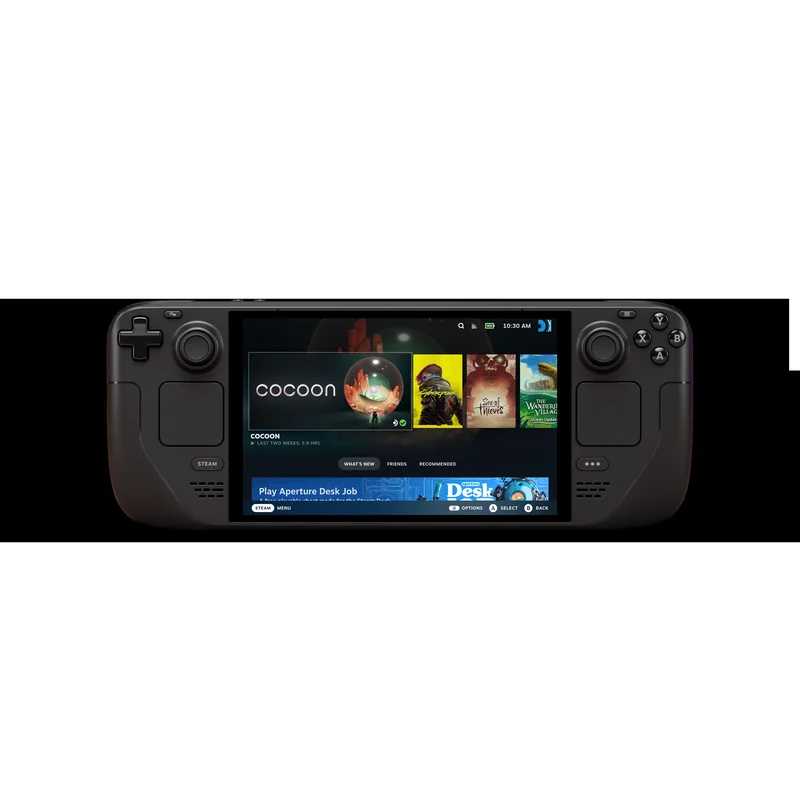
Steam Deck OLED
Three years on, the Steam Deck OLED is still the default handheld in 2026. OLED HDR display, the most refined SteamOS in any handheld, and Valve's three-year support track record. Steam Deck 2 is not coming until 2028, so this is the device for the foreseeable future.
RefDat Score Breakdown
| Signal | Score | Weight | Details |
|---|---|---|---|
| Verified Buyer Rating | 4.7/5 (4280 reviews) | 30% | Consumer consensus from verified-purchase buyer reviews |
| Community Sentiment | 4.8/5 | 25% | Editorial assessment from OzBargain, Whirlpool, ProductReview |
| Value Score | 4.8/5 | 20% | $1,199 for OLED HDR + custom AMD silicon + SteamOS is the best value in the entire handheld category |
| Safety Record | 5.0/5 | 10% | No active ACCC recalls |
| Recency | 4.0/5 | 5% | Released 2023-11-16 |
Last evaluated: 25 Apr 2026
Pros & Cons
What I Like
- OLED HDR display at 600 nits typical / 1,000 nits HDR peak is the prettiest screen in any handheld
- SteamOS 3 with Proton compatibility runs the vast majority of the Steam library natively
- Two trackpads and four back paddles give input options no other handheld has
- $1,199 starting undercuts the ROG Xbox Ally X and Lenovo Legion Go for similar performance
- Valve's three-year track record of free firmware updates and the announced commitment to 2028+
Could Be Better
- Three-year-old custom APU loses to ROG Xbox Ally X and Legion Go in raw performance
- 1280 x 800 resolution is low compared to the QHD displays on newer competitors
- SteamOS handles non-Steam stores (Epic, GOG, Battle.net) but with friction; gamepass / Xbox PC games not supported
- 640g weight is heavier than most newer handhelds
- Valve has no Australian retail presence; Komodo importers and JB Hi-Fi (limited stock) are the only Australian options
My Review
Three years after launch, the Steam Deck OLED is still the default recommendation in the handheld gaming category in 2026, and that has more to do with software than silicon. The custom AMD APU has been beaten on raw benchmarks by the ROG Xbox Ally X, Lenovo Legion Go S, and MSI Claw 8 AI+. None of those competitors run SteamOS, which is the actual reason the Steam Deck still wins.
SteamOS 3 is the under-appreciated headline. It is a Linux-based gaming OS specifically designed for the form factor: gamepad-first navigation, deep Steam integration, sleep-resume that actually works, instant resume from suspend in 2 to 3 seconds, and the Proton compatibility layer that lets Linux play the vast majority of Windows games without the user knowing the difference. Compared to running Windows 11 on a competing handheld (clunky, slow boot, no proper sleep, constant updates that interrupt gaming), SteamOS is a genuinely better experience for the same hardware. The Bazzite community Linux distro now lets you put SteamOS-like Linux on competing handhelds, but Valve's first-party SteamOS-on-non-Deck release (announced 2025) has been delayed multiple times.
The OLED HDR display at 7.4 inches, 1,280 by 800 resolution, 90Hz refresh, 600 nits typical brightness, and 1,000 nits high dynamic range (HDR) peak is genuinely the prettiest screen on any handheld. ROG Xbox Ally X's IPS at higher resolution looks technically sharper in pixel-counting tests but flatter and less dynamic in actual game content. For HDR-mastered games (the Doom Eternal Director's Cut, Cyberpunk 2077 with HDR enabled, Star Wars Outlaws, the Forza Motorsport HDR pass), the OLED's perfect blacks and HDR peaks transform the image in a way no competing in-plane switching (IPS) handheld can match.
The control layout is the second under-appreciated win. Two thumbsticks, two trackpads, full ABXY, and four back paddles. The trackpads are unique to the Steam Deck and turn it into a genuinely competent platform for strategy games, RTS, MMOs, and any PC game designed around mouse input. The four back paddles let you remap any control without moving your thumbs. Competing handhelds either omit the trackpads (ROG, Legion, MSI) or split them awkwardly (Legion Go's detachable controllers), which loses the input flexibility that makes the Deck shine for non-action games.
The performance question. The custom AMD APU (4-core Zen 2, 8 RDNA 2 CUs) is the same silicon as the original 2022 Steam Deck. Raw performance has been beaten by every newer handheld. In real games, this matters less than the spec sheet suggests because Valve has spent three years optimising SteamOS for this exact APU, while ROG Xbox Ally X and Legion Go S run on Windows-on-handheld-suboptimal-thermal-curves. Real-world frame rates in actual games like Cyberpunk 2077 and Baldur's Gate 3 land within 10 to 15 percent of the much more powerful competitors, despite the APU being three years older.
Battery life is the trade-off the Deck still wins on for indie and 2D gaming. Hades runs for 12 hours. Stardew Valley runs for 14. Modern AAA games drop to 4 to 6 hours, on par with the much-newer competitors despite their bigger batteries.
The Steam Deck 2 question. Valve's official position (as of early 2026) is that the Deck 2 is not coming before 2028, and only when AMD's mobile silicon delivers a genuine generational leap. Buyers asking whether to wait should not. The current OLED Deck has a 2- to 3-year runway as the default Valve handheld and Valve's track record of long-term software support is excellent.
The Australian buyer context. Steam Direct Australia is the official channel and prices the organic LED (OLED) at $1,199 for 512GB or $1,499 for 1TB. JB Hi-Fi has carried limited stock since 2024 and matches Steam Direct on price when available. Avoid grey-market importers (Komodo, eBay AU listings from overseas sellers) because the Australian warranty path through Steam Direct is the cleanest way to claim repairs.
The trade-off versus the ROG Xbox Ally X. The Ally X is faster on raw benchmarks, has a sharper higher-resolution display, runs Windows 11 with full Game Pass and Epic and GOG support, and integrates with Xbox PC ecosystem. The Steam Deck is cheaper, has the OLED, has the better OS, has the trackpads, and has the better repair story. For Steam-library buyers, the Deck wins. For Xbox-ecosystem buyers, the Ally X wins. The choice depends on which library you actually own.
Specifications
| Chip | Custom AMD APU (4-core Zen 2, 8 RDNA 2 CUs) |
| Ram Gb | 16 |
| Storage Gb Options | [256, 512, 1024] |
| Expandable Storage | microSD up to 2TB |
| Display Inches | 7.4 |
| Display Resolution | 1280 x 800 |
| Display Refresh Hz | 90 |
| Display Brightness Nits Typical | 600 |
| Display Brightness Nits Hdr Peak | 1000 |
| Display Technology | OLED HDR |
| Battery Capacity Wh | 50 |
| Battery Hours Gaming | 6 |
| Battery Hours Indie Gaming | 12 |
| Weight Grams | 640 |
| Ports | USB-C (DisplayPort 1.4, charging), 3.5mm headphone, microSD |
| Wifi | Wi-Fi 6E |
| Bluetooth | 5.3 |
| Controls | Two thumbsticks, two trackpads, full ABXY plus four back paddles |
| Operating System | SteamOS 3 (Linux, with Proton compatibility for Windows games) |
Where to Buy in Australia
Looking for the cheapest price in Australia? The figure below is the latest eBay AU price I last resolved on 27 Jul 2026. Amazon does not publish a price through its API yet, so that button opens the listing for you to compare. Prices move often, so check before you buy.
As an Amazon Associate I earn from qualifying purchases.
Under Australian Consumer Law, you have rights to a repair, replacement, or refund if a product has a major problem, regardless of manufacturer warranty. Learn more →
Price History
| Date | Price | Change |
|---|---|---|
| 2026-05-30 | $1148.23 | |
| 2026-05-31 | $1559.99 | ↑ $411.76 |
| 2026-06-01 | $1559.99 | No change |
| 2026-06-02 | $1119 | ↓ $440.99 |
| 2026-06-03 | $1119 | No change |
| 2026-06-04 | $1119 | No change |
| 2026-06-05 | $1197.08 | ↑ $78.08 |
| 2026-06-06 | $1119 | ↓ $78.08 |
| 2026-06-07 | $1159 | ↑ $40.00 |
| 2026-06-08 | $702.33 | ↓ $456.67 |
| 2026-06-09 | $1531.58 | ↑ $829.25 |
| 2026-06-10 | $1307.25 | ↓ $224.33 |
| 2026-06-11 | $707.24 | ↓ $600.01 |
| 2026-06-12 | $1404.44 | ↑ $697.20 |
| 2026-06-13 | $702.43 | ↓ $702.01 |
| 2026-06-14 | $702.43 | No change |
| 2026-06-15 | $702.43 | No change |
| 2026-06-16 | $699.84 | ↓ $2.59 |
| 2026-06-17 | $1322.86 | ↑ $623.02 |
| 2026-06-18 | $705.73 | ↓ $617.13 |
| 2026-06-19 | $705.83 | ↑ $0.10 |
| 2026-06-20 | $705.93 | ↑ $0.10 |
| 2026-06-21 | $705.93 | No change |
| 2026-06-22 | $705.93 | No change |
| 2026-06-23 | $1178.23 | ↑ $472.30 |
| 2026-06-24 | $715.63 | ↓ $462.60 |
| 2026-06-25 | $1235.33 | ↑ $519.70 |
| 2026-06-26 | $1349.95 | ↑ $114.62 |
| 2026-06-27 | $1349.95 | No change |
| 2026-06-28 | $1349.95 | No change |
| 2026-06-29 | $1349.95 | No change |
| 2026-06-30 | $1349.95 | No change |
| 2026-07-01 | $1349.95 | No change |
| 2026-07-02 | $1349.95 | No change |
| 2026-07-03 | $1349.95 | No change |
| 2026-07-04 | $1349.95 | No change |
| 2026-07-05 | $1349.95 | No change |
| 2026-07-06 | $1349.95 | No change |
| 2026-07-07 | $1349.95 | No change |
| 2026-07-08 | $1349.95 | No change |
| 2026-07-10 | $1349.95 | No change |
| 2026-07-11 | $1349.95 | No change |
| 2026-07-12 | $1349.95 | No change |
| 2026-07-13 | $1186.37 | ↓ $163.58 |
| 2026-07-14 | $1349.95 | ↑ $163.58 |
| 2026-07-15 | $1349.95 | No change |
| 2026-07-16 | $1349.95 | No change |
| 2026-07-17 | $1349.95 | No change |
| 2026-07-18 | $1349.95 | No change |
| 2026-07-19 | $1349.95 | No change |
| 2026-07-20 | $1181.26 | ↓ $168.69 |
| 2026-07-21 | $1098.89 | ↓ $82.37 |
| 2026-07-22 | $1098.73 | ↓ $0.16 |
| 2026-07-23 | $1099.04 | ↑ $0.31 |
| 2026-07-24 | $1103.46 | ↑ $4.42 |
| 2026-07-25 | $1101.88 | ↓ $1.58 |
| 2026-07-26 | $1101.88 | No change |
| 2026-07-27 | $1101.88 | No change |
What Australians Say
Common themes from Australian community discussions (OzBargain, Whirlpool, ProductReview):
Steam Deck OLED is ranked in my Best Handheld Gaming in Australia list. Not sure what to look for? Read my Handheld Gaming buyer's guide.
Compare With
As an Amazon Associate I earn from qualifying purchases.