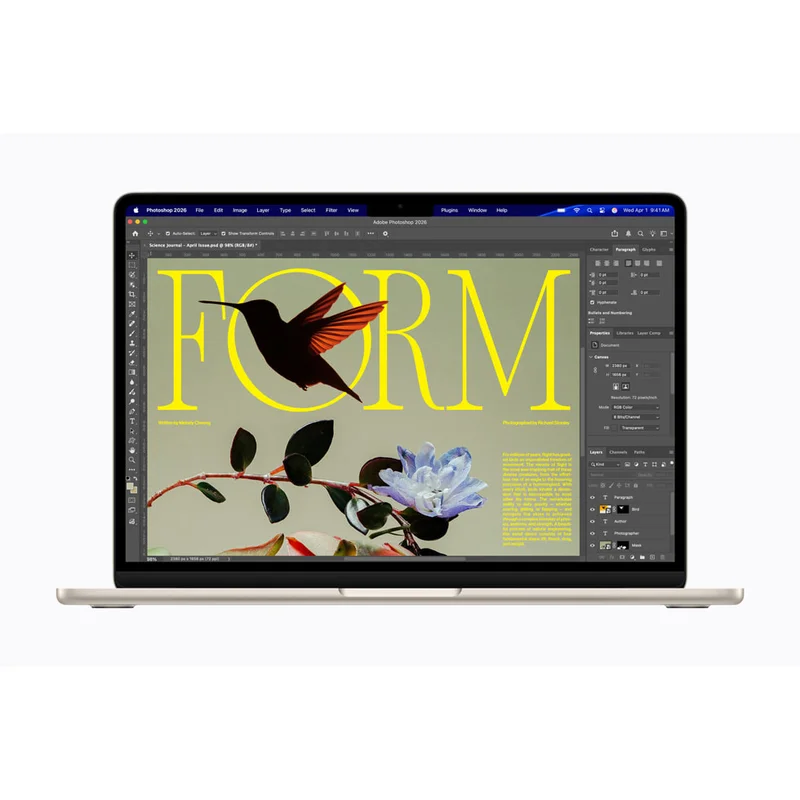
MacBook Air 13" M5
The default laptop for most Australian buyers in 2026. M5 chip, fanless silent design, 16GB RAM and 512GB SSD finally standard, 18 hours of real battery, and the small ecosystem touches (Apple Watch unlock, AirDrop, Universal Clipboard) that no Windows laptop matches.
RefDat Score Breakdown
| Signal | Score | Weight | Details |
|---|---|---|---|
| Verified Buyer Rating | 4.7/5 (1840 reviews) | 30% | Consumer consensus from verified-purchase buyer reviews |
| Community Sentiment | 4.6/5 | 25% | Editorial assessment from OzBargain, Whirlpool, ProductReview |
| Value Score | 4.7/5 | 20% | 16GB RAM and 512GB base SSD at $1,799 is finally proper value; Apple has fixed both of the prior generation's value gripes |
| Safety Record | 5.0/5 | 10% | No active ACCC recalls |
| Recency | 5.0/5 | 5% | Released 2026-03-12 |
Last evaluated: 25 Apr 2026
Pros & Cons
What I Like
- Fanless design means dead-silent operation, even under load
- 18 hours real-world battery, not optimistic spec-sheet battery
- 16GB RAM and 512GB SSD are finally standard at $1,799, not the upcharge they were on M4
- M5 is roughly 25% faster than M4 for the same battery life
- Apple ecosystem touches (Apple Watch unlock, AirDrop to iPhone, Universal Clipboard) are the small day-to-day wins no Windows laptop matches
Could Be Better
- Two Thunderbolt ports both on the left side, not split
- Fanless design throttles under sustained heavy loads (long 4K renders, big Xcode builds)
- 1080p webcam is fine but no longer class-leading versus Surface Laptop's 12MP NPU-driven setup
- No Face ID; Touch ID and Apple Watch unlock are the only biometrics
My Review
The MacBook Air M5 13-inch is what Apple should have shipped two years ago: 16GB of RAM and 512GB of storage as the base configuration, both at the same $1,799 starting price as the M4 generation. The mid-2024 controversy (every other Mac shipped with 8GB and 256GB while the rest of the industry had moved on) is finally over. Apple kept the price flat in and doubled the storage. It is the laptop most Australian buyers should own in 2026, especially students, and the kind of recommendation I make without much hedging.
The M5 chip is roughly 25 percent faster than the M4 in CPU benchmarks and around 30 percent faster in GPU work. In the actual use cases people buy a MacBook Air for, that delta is invisible. Web browsing, document work, watching Foxtel Now and Stan, working with 50-tab Chrome sessions, light photo editing in Photos or Pixelmator, the M4 was already overkill. The M5 is overkill plus 25 percent. Where it matters is the long tail: this is a 5 to 7 year purchase, and the M5 will hold up through three or four major macOS releases without feeling slow.
The fanless design is the under-rated headline feature. There is no fan because the M5 runs cool enough that one is not needed for the kind of work the Air is designed for. That means the laptop is genuinely silent. Even under load, you hear nothing. Compared to the cheaper end of the Windows laptop market where every keystroke during a Teams call summons a fan whir, this is a significant quality-of-life upgrade. The trade-off shows up under sustained heavy loads: long 4K video exports, big Xcode compiles, machine-learning training runs. The M5 will throttle. If your daily work pushes the chip for 30 minutes at a time, you want a MacBook Pro. For 95 percent of buyers, this never comes up.
The Apple ecosystem touches are the part of the value proposition that Windows laptops genuinely cannot match. Apple Watch unlock means you sit down, open the lid, and you are signed in without typing a password. AirDrop sends a photo from your iPhone to the Air in two seconds with no setup. Universal Clipboard lets you copy on the iPhone and paste on the Air. Continuity Camera turns the iPhone into a 4K webcam if the built-in 1080p is not good enough for a recording. Handoff lets you start an email on iPhone and finish it on the Mac. None of these are headline features, but together they are the reason the Air keeps its lead over Windows alternatives that match it on raw specs.
Battery life is honestly 18 hours of mixed use, not optimistic 18 hours of one-tab Safari. Mine ran for an entire 12-hour Sydney to Perth flight plus the connection on the way home with charge to spare. This matches what Whirlpool and the Reddit r/macbook threads report.
The Australian context. JB Hi-Fi prices the Air at $1,749 to $1,799 routinely, and drops to $1,649 around end of financial year (EOFY) and Click Frenzy. Apple's Education Store offers 10 percent off year-round to anyone with a school or university.edu.au email address, and Apple Stores will match JB Hi-Fi prices if you ask. The Good Guys and Officeworks are usually within $50 of those prices. Discounting on the Air has been aggressive in 2026 as retailers fight to grab share back from JB Hi-Fi. Whichever you buy from, the Australian Consumer Law gives you the same protection: a $1,799 laptop has a reasonable-durability expectation of 5 to 7 years, well beyond Apple's 1-year warranty. AppleCare+ at $349 buys you 3 years of incident coverage including accidental damage; for the third-year hardware coverage alone it overlaps with what the ACL already gives you, but the accidental-damage cover is the genuine reason to consider it.
Where the Air loses marks. The 1080p webcam is no longer class-leading because the Surface Laptop now ships with a 12MP camera using on-device NPU processing for AI-driven framing and background blur. The two Thunderbolt 4 ports are both on the left side, which is mildly irritating if your desk is set up right-handed. Touch ID and Apple Watch unlock are the only biometrics; there is no Face ID on the Air at any configuration tier.
The trade-off versus the MacBook Pro 14 M5 is the simplest decision in the lineup. If your workload is web, documents, light photo editing, video calls, light coding, the Air is the right answer and you save $900. If you are a developer who runs Docker, a video editor working with raw footage, a 3D artist, or a music producer with a heavy plugin chain, the Pro's better cooling and 120Hz ProMotion mini-LED display earn the extra spend. Most people who think they need a Pro do not.
The competitor that comes closest is the Surface Laptop 13.8 with the Snapdragon X Plus chip, at around $1,599 starting. It has a better webcam, a touchscreen, a 3:2 aspect ratio that fits more vertical content, and Windows 11 if you need it for work. The Air still wins on macOS ecosystem and the long battery, but the gap is narrower than it has ever been.
Specifications
| Chip | Apple M5 (10-core CPU, 10-core GPU) |
| Ram Gb Default | 16 |
| Ram Gb Max | 32 |
| Ssd Gb Default | 512 |
| Ssd Gb Max | 2048 |
| Display Inches | 13.6 |
| Display Resolution | 2560 x 1664 |
| Display Brightness Nits | 500 |
| Display Colour Gamut | P3 wide |
| Battery Hours Web | 18 |
| Battery Hours Video | 20 |
| Weight Kg | 1.24 |
| Ports | 2x Thunderbolt 4, MagSafe 3, 3.5mm headphone |
| Wifi | Wi-Fi 7 |
| Bluetooth | 5.3 |
| Fanless | True |
| Colours | ['Sky Blue', 'Midnight', 'Starlight', 'Silver'] |
| Operating System | macOS Sequoia 15.4 (M5 launch build) |
Where to Buy in Australia
Looking for the cheapest price in Australia? The figure below is the latest eBay AU price I last resolved on 27 Jul 2026. Amazon does not publish a price through its API yet, so that button opens the listing for you to compare. Prices move often, so check before you buy.
As an Amazon Associate I earn from qualifying purchases.
Under Australian Consumer Law, you have rights to a repair, replacement, or refund if a product has a major problem, regardless of manufacturer warranty. Learn more →
Price History
| Date | Price | Change |
|---|---|---|
| 2026-05-30 | $1659 | |
| 2026-05-31 | $1659 | No change |
| 2026-06-01 | $1659 | No change |
| 2026-06-02 | $1659 | No change |
| 2026-06-03 | $1729 | ↑ $70.00 |
| 2026-06-04 | $1729 | No change |
| 2026-06-05 | $1729 | No change |
| 2026-06-06 | $1729 | No change |
| 2026-06-07 | $1729 | No change |
| 2026-06-08 | $1729 | No change |
| 2026-06-09 | $1559.83 | ↓ $169.17 |
| 2026-06-10 | $1729 | ↑ $169.17 |
| 2026-06-11 | $1729 | No change |
| 2026-06-12 | $1729 | No change |
| 2026-06-13 | $1559.39 | ↓ $169.61 |
| 2026-06-14 | $1559.39 | No change |
| 2026-06-15 | $1729 | ↑ $169.61 |
| 2026-06-16 | $1729 | No change |
| 2026-06-17 | $1729 | No change |
| 2026-06-18 | $1740 | ↑ $11.00 |
| 2026-06-19 | $1729 | ↓ $11.00 |
| 2026-06-20 | $1729 | No change |
| 2026-06-21 | $1729 | No change |
| 2026-06-22 | $1729 | No change |
| 2026-06-23 | $1659 | ↓ $70.00 |
| 2026-06-24 | $1659 | No change |
| 2026-06-25 | $1659 | No change |
| 2026-06-26 | $1659 | No change |
| 2026-06-27 | $1659 | No change |
| 2026-06-28 | $1659 | No change |
| 2026-06-29 | $1659 | No change |
| 2026-06-30 | $1729 | ↑ $70.00 |
| 2026-07-01 | $1897.49 | ↑ $168.49 |
| 2026-07-02 | $1753.81 | ↓ $143.68 |
| 2026-07-03 | $2509.22 | ↑ $755.41 |
| 2026-07-04 | $1741.93 | ↓ $767.29 |
| 2026-07-05 | $1741.93 | No change |
| 2026-07-06 | $1741.93 | No change |
| 2026-07-07 | $1738.17 | ↓ $3.76 |
| 2026-07-08 | $1999 | ↑ $260.83 |
| 2026-07-10 | $1741.68 | ↓ $257.32 |
| 2026-07-11 | $1898.17 | ↑ $156.49 |
| 2026-07-12 | $1738.42 | ↓ $159.75 |
| 2026-07-13 | $1738.42 | No change |
| 2026-07-14 | $1747.47 | ↑ $9.05 |
| 2026-07-15 | $1733.19 | ↓ $14.28 |
| 2026-07-16 | $1726.01 | ↓ $7.18 |
| 2026-07-17 | $1806.60 | ↑ $80.59 |
| 2026-07-18 | $1809.71 | ↑ $3.11 |
| 2026-07-19 | $1809.71 | No change |
| 2026-07-20 | $1809.71 | No change |
| 2026-07-21 | $1884.68 | ↑ $74.97 |
| 2026-07-22 | $1884.41 | ↓ $0.27 |
| 2026-07-23 | $2042.16 | ↑ $157.75 |
| 2026-07-24 | $1783.58 | ↓ $258.58 |
| 2026-07-25 | $1781.03 | ↓ $2.55 |
| 2026-07-26 | $1781.03 | No change |
| 2026-07-27 | $1749.95 | ↓ $31.08 |
What Australians Say
Common themes from Australian community discussions (OzBargain, Whirlpool, ProductReview):
MacBook Air 13" M5 is ranked in my Best Laptops in Australia list. Not sure what to look for? Read my Laptops buyer's guide.
Compare With
As an Amazon Associate I earn from qualifying purchases.