How to Choose an Espresso Machine - Buyer's Guide
Last updated: 19 Apr 2026
Portafilter Size: 54mm vs 58mm vs 51mm, and Why It Matters
This is the single most important spec on an espresso machine and the one most buyers miss. 58mm is the global commercial standard. Every serious aftermarket basket (IMS, VST), every competition tamper (Pesado, Normcore, Levercraft), every bottomless portafilter from AliExpress or eBay, every distribution tool, they all default to 58mm. It is the format every commercial cafe uses and every prosumer machine uses.
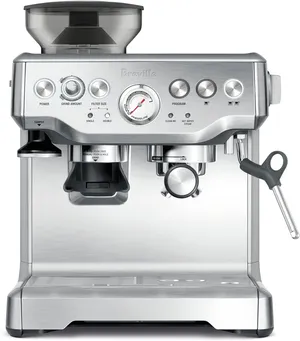
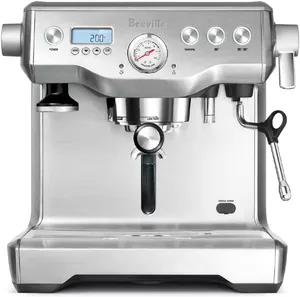
Breville's mid-range uses 54mm, which is a Breville-specific standard. The Barista Express, Barista Pro, Bambino Plus and Barista Touch Impress are all 54mm. The aftermarket for 54mm is smaller than 58mm but still well-stocked in 2026: IMS makes precision baskets, Normcore makes distribution tools and tampers, bottomless portafilters are available. Think of it as 70 to 80 percent of the 58mm aftermarket. The Breville Dual Boiler is the only Breville machine in this guide that uses 58mm, which is a large part of why it is the enthusiast pick.
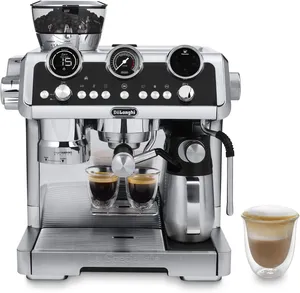
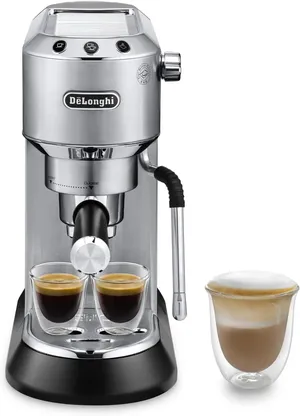
De'Longhi's Dedica Arte uses 51mm, which is the worst of the three standards. The 51mm aftermarket is tiny and De'Longhi-specific. If you start on 51mm and upgrade to a real machine later, none of your baskets or tampers transfer. The La Specialista Maestro also uses 51mm despite its $999 price, which is one of the reasons it loses the head-to-head against the Breville Dual Boiler.
Sunbeam's Barista Max uses 58mm commercial standard, which is genuinely the best portafilter size in this guide at sub-$700 money. The Sunbeam's reliability record is the reason it does not win despite this.
The practical test: if you plan to spend under $700 and treat this as a 5-year purchase, 54mm is fine. If you plan to upgrade one day, 58mm preserves your accessories. If you are on a sub-$250 budget, 51mm is the compromise you accept. Do not buy a 51mm machine at $1,000 (looking at you, La Specialista Maestro) when a 58mm machine exists at the same money.
Integrated Grinder or Separate Grinder
This is the decision that drives your total setup cost. An integrated grinder (Barista Express, Barista Pro, Barista Touch Impress, Sunbeam Barista Max) means the machine is a single-box solution. You load beans into the hopper, grind straight into the portafilter, pull the shot. No separate appliance. No extra bench space. Usually $200 to $500 cheaper than a machine plus a standalone grinder.
The trade-off is grinder quality. Every integrated grinder in this guide is a 16-to-30 step conical burr that is fine for medium-roast commercial beans (Campos Superior, Ona House Blend, Coles Grown) but not as good as a dedicated $400 Breville Smart Grinder Pro or a $900 Niche Zero. Integrated grinders produce more fines (the too-fine particles that cause channelling in the puck) and less consistent particle size distribution. For daily flat whites from a medium-roast bag, you will not notice. For light-roast specialty beans where 0.5mm of grind adjustment changes everything, you will.
A separate grinder (paired with a Bambino Plus, Dual Boiler or Dedica Arte) pushes total setup cost up by $250 to $900. A Baratza Encore at $299 is the entry level. A Breville Smart Grinder Pro at $399 is the value pick. A Niche Zero at $900 is the end-game. The upside: better shot quality, finer adjustment, and a grinder that outlasts the machine (grinders have fewer failure points than espresso machines).
My take for 2026: if you are new to espresso and want a working setup out of the box, buy a Barista Express with its integrated grinder. If you already own a decent grinder, buy a Bambino Plus or a Dual Boiler and pair it with what you have. If you are serious about light-roast specialty coffee, budget for a separate grinder no matter which machine you pick.
Boiler Technology: Thermocoil, ThermoJet, Single Boiler, Dual Boiler, Heat Exchanger
The heating system inside the machine determines how fast it gets to temperature, how stable it holds temperature, and whether you can steam milk and pull espresso at the same time. There are four common architectures in the Australian market.
ThermoCoil is Breville's traditional single-boiler heating system, used on the Barista Express. A coil of metal wrapped around the water path, heated by an element. Takes about 30 seconds to reach ready. Holds temperature within about 3C across 10 back-to-back shots. Cannot steam and pull simultaneously, you switch modes and wait. Simple, reliable, 10 years of field data.
ThermoJet is Breville's next-generation thermocoil, used on the Barista Pro, Bambino Plus and Barista Touch Impress. Same architecture as ThermoCoil but with a more aggressive heating element that hits ready in 3 seconds from cold. Same thermal stability as ThermoCoil (not better, just faster). Same sequential pull-then-steam workflow. Less long-term reliability data because ThermoJet is newer.
Single boiler is an older architecture used on the De'Longhi Dedica Arte: a small pressurised boiler that heats water for both brewing and steaming, but only one at a time. Slower to heat than thermocoil (40 to 60 seconds from cold). Less thermally stable because the boiler has to switch temperatures between brew (92C) and steam (135C).
Dual boiler is the prosumer architecture on the Breville Dual Boiler: two separate pressurised boilers, one for brew and one for steam, running simultaneously at different temperatures. You can pull espresso and steam milk at the same time, which transforms the workflow for multi-drink households. Takes 10 to 15 minutes to fully thermally stabilise from cold. Holds brew temperature within 0.5C across 20 shots with triple PID.
Heat exchanger is an Italian commercial architecture (E61 group head machines) not well-represented in Australia under $1,500, so not covered here. If you are shopping in the $2,000 plus range, you are looking at heat exchanger or double-boiler commercial territory.
Dual heating system is De'Longhi's term for two thermoblocks running simultaneously, as on the La Specialista Maestro. Lighter weight than a true dual boiler, faster to heat, but less thermally stable under sustained load.
Practical summary: for one or two drinks a morning, any of these work. For a brunch where you are making six flat whites in a row, dual boiler wins clearly.
PID Temperature Control
PID stands for Proportional Integral Derivative, a control algorithm that holds temperature within a tight window instead of letting it swing. Espresso extraction is temperature-sensitive: 1C difference in brew temperature changes flavour noticeably, especially for light-roast specialty beans.
Every machine in this guide has some form of PID temperature control except the De'Longhi Dedica Arte (which is a simple thermostat). But there are levels. The Barista Express, Pro, Bambino Plus, Touch Impress and Sunbeam Barista Max all have single-point PID on the brew element. The Breville Dual Boiler has triple PID (brew boiler, steam boiler, group head), each with its own control loop, holding within 0.5C under load.
If you pull medium-roast commercial beans and drink milk-based drinks, single-point PID is enough. If you pull light-roast specialty beans from Campos, Ona or Seven Seeds, triple PID or a heat-exchanger setup is where you want to be, because the grind window for light roasts is tighter and thermal drift shows up in the cup.
Adjustable PID (the ability to tune brew temperature in 1C steps from the machine) is a prosumer feature on the Dual Boiler and not available on any other machine in this guide. Useful for serious enthusiasts, irrelevant for 90 percent of buyers.
Steam Wand Types: Panarello vs Manual vs Automatic
Milk steaming is half of what makes a flat white or a latte. The wand type determines how much control you have and how steep the learning curve is.
Panarello wands (De'Longhi Dedica Arte) are single-hole steam nozzles surrounded by a plastic sleeve that aerates milk mechanically. Easy to use, impossible to control. Produces warm foamy milk, not silky microfoam. Latte art is a struggle. The community mod is to remove the plastic sleeve and swap to a Rancilio Silvia steam tip from Coffee Parts (about $15, 20-minute job), which transforms the steaming performance.
Manual professional wands (Barista Express, Barista Pro, Dual Boiler, Sunbeam Barista Max) are open steam nozzles with one or two tip holes. You position the jug, angle the wand, control the stretch (air introduction) and the texture (roll to homogenise). A skill that takes about 50 drinks of practice to learn, produces genuine microfoam, supports latte art. The right choice if you want to learn the craft.
Automatic steam wands (Bambino Plus auto mode, Barista Touch Impress Auto MilQ, La Specialista Maestro MyLatteArt auto mode) texture milk hands-free to preset temperature and foam density. Press a button, walk away, get microfoam. Easiest path to consistent results for beginners. Loses some manual control that experienced baristas want. The original Auto MilQ on the discontinued Barista Touch BES880 had a notorious ER05 reliability issue. The Barista Touch Impress BES881 and the Bambino Plus have redesigned auto wands that appear to have resolved that pattern.
Hybrid manual-plus-auto wands (Bambino Plus, La Specialista Maestro MyLatteArt, Barista Touch Impress) give you both options on the same wand. A good feature: use auto mode when you are in a hurry, switch to manual mode when you want to practice.
My recommendation: if you want to learn, buy a manual wand. If you want convenience and hands-free lattes, buy a hybrid auto wand. If you buy a panarello-wand machine, budget $15 for the Silvia tip mod on day one.
Water Reservoir Capacity and Plumbing
Water tank size determines how often you refill, which is a small but constant daily annoyance. Most home machines are pour-fill (you lift the tank and refill at the sink). The Dual Boiler is the only machine in this guide with a direct plumb option (permanent water line connection), though the plumb kit is extra and requires plumbing work.
Reservoir sizes in this guide: Dedica Arte 1.1L (smallest, 8 to 10 shots), Bambino Plus 1.9L (12 to 15 shots), Barista Express, Pro and Touch Impress 2L (15 to 18 shots), La Specialista Maestro 2L (16 to 18 shots), Dual Boiler 2.5L (20 to 22 shots), Sunbeam Barista Max 2.8L (22 to 26 shots).
For a single-drink household, any tank is fine. For a two-drink morning, 1.9L or larger avoids a daily refill. For a multi-drink brunch or a small-office setup, 2.5L plus or plumbed-in is the move.
Filtration matters for machine longevity. Sydney and Melbourne tap water is hard enough that unfiltered use will scale the boiler within 2 to 3 years. The Breville machines include a basic carbon filter in the tank. For best protection, use filtered water (Brita jug is fine) and descale every 2 to 3 months. Descaling is your maintenance obligation under ACL, not a warranty claim when scaling kills the machine.
Grind Settings and Why Resolution Matters
Espresso grind needs to be adjustable in small steps because the extraction window is tight: a shot pulled 3 seconds too fast is under-extracted and sour, a shot pulled 3 seconds too slow is over-extracted and bitter. The grinder controls that.
Grinder resolution (number of steps between finest and coarsest) in this guide: La Specialista Maestro 8 steps (too few for light roasts), Barista Express 16 steps (fine for medium roasts, tight for light), Barista Touch Impress 25 steps (good), Barista Pro and Sunbeam Barista Max 30 steps (good), separate grinders like the Breville Smart Grinder Pro 60 plus steps (best).
The practical test: if you pull a light-roast Campos Superior at 18 grams in and target 36 grams out in 28 seconds, can you hit that number within one or two grind adjustments? On 8 steps, you cannot, because the jump between settings is too large. On 16 steps, usually yes. On 30 steps, easily. On 60 plus steps, it is a non-issue.
For medium-roast commercial beans where the extraction window is wider (22 to 32 seconds is all acceptable), 8 to 16 steps is fine. For light-roast specialty beans, 30 steps is the minimum for a sane dial-in.
Stepless grinders (some Italian grinders, the Niche Zero) have infinite resolution within the adjustment range. They are the end-game for home baristas. None of the integrated grinders in this guide are stepless.
Budget, Mid-Range and Premium Tier Buyer Guidance
Budget tier ($150 to $300): De'Longhi Dedica Arte at $199 is the only machine in this price range worth buying in 2026. Below $150 you are in pressurised-pod and Kmart-special territory that does not pull actual espresso. The budget tier is specifically the $199 way to find out whether you like making espresso at home. Most buyers upgrade within 12 to 18 months. That is the point. Expected lifespan: 4 to 6 years with maintenance. Needs a $100 to $300 grinder or a commitment to E.S.E. pods.
Mid-range ($400 to $800): The Breville Bambino Plus ($449 to $549), Breville Barista Express ($490 to $699), Breville Barista Pro ($850 to $950), and Sunbeam Barista Max ($549 to $699) all live here. This is where most home enthusiasts should spend. The Barista Express is the default recommendation: single-box solution with integrated grinder, manual wand, proven 8-year reliability record. The Bambino Plus is the pick if you already own a grinder or need a compact footprint. The Barista Pro is the Express with a faster heater and a finer grinder for $200 to $300 more. The Sunbeam has the best feature set on paper but the weakest reliability record. Expected lifespan: 6 to 8 years with maintenance.
Premium tier ($800 plus): The De'Longhi La Specialista Maestro at $999, the Breville Dual Boiler at $1,212 to $1,299, and the Breville Barista Touch Impress at $1,549 to $1,799 are the premium options. The Dual Boiler is the enthusiast pick (58mm commercial, dual boiler, triple PID, 10 to 15 year expected lifespan) and the value leader at this tier despite the higher sticker. The Barista Touch Impress is the convenience pick (auto-tamp, touchscreen, hands-free milk). The La Specialista Maestro is the cold-brew and smart-tamping pick that loses to the Dual Boiler on cup quality. Expected lifespan: 10 to 15 years with maintenance.
Australian Consumer Law and Expected Lifespan
The ACL's consumer guarantee is the most important protection you have as an Australian buyer. It applies on top of any manufacturer warranty, and it is not optional, sellers cannot contract out of it. The core test is 'reasonable durability': a machine should last as long as a reasonable consumer would expect for the price paid. The warranty card is not the ceiling.
Practical durability expectations in this guide: budget tier ($150 to $300) 4 to 6 years, mid-range ($400 to $800) 6 to 8 years, premium ($800 to $1,500) 8 to 12 years, prosumer ($1,500 plus) 10 to 15 years. Those are what a court or the ACCC would consider reasonable, not what the warranty card says. Breville's 1 to 2 year warranty is the floor, not the full expectation.
The claim process is always retailer first, not manufacturer first. If your machine fails within the reasonable-durability window, take it back to where you bought it (JB Hi-Fi, The Good Guys, Harvey Norman, Breville Direct, De'Longhi Direct, Sunbeam Direct, whoever issued the tax invoice). The retailer carries the ACL obligation. They cannot send you away because the 1 or 2 year warranty has expired. They can either repair, replace, or refund at their option. They will usually loop the manufacturer's support team in, but the claim is against the retailer.
Document your case. Keep the tax invoice. Photograph the failure mode. Reference the ACCC's guidance on 'reasonable durability' at accc.gov.au. If the retailer refuses, escalate to the ACCC or to your state's consumer affairs body (Fair Trading NSW, Consumer Affairs Victoria, OFT Queensland, etc).
Your maintenance obligation is real: descale every 2 to 3 months, backflush the group head weekly with water and monthly with cleaner, replace water filters as scheduled. If you fail to do maintenance and the machine scales up or blocks, that is your fault, not the retailer's. If you do maintenance and the pump dies at year four, that is the retailer's obligation.
Retailer Coverage and Service Network (The Breville AU Advantage)
All major Australian retailers sell the Breville, De'Longhi and Sunbeam lines: JB Hi-Fi, The Good Guys, Harvey Norman, Appliances Online, Myer, David Jones, and each manufacturer's direct store. For parts and service you also have Coffee Parts (coffeeparts.com.au) and Alternative Brewing (alternativebrewing.com.au), both of which stock OEM Breville gear and some De'Longhi and Sunbeam parts.
The service network is where Breville pulls ahead. Breville Australia is headquartered in Sydney and operates authorised service centres in every capital city. Their 1300 139 798 support line picks up. Every spare part is orderable direct from breville.com.au, from a $7 group head gasket up to a full grinder assembly or boiler module. YouTube has 50 plus repair videos for the Barista Express alone, 40 plus for the Dual Boiler. Third-party Australia repair shops (Whole Latte Love Australia, Barista Warehouse, local specialty coffee shops) service Breville. The combination is the best parts-and-service network in the category by a wide margin, and it is the single biggest reason Breville wins three of four picks in the accompanying best-of list.
De'Longhi Australia exists on 1800 126 659. Authorised service centres are in major cities but the footprint is smaller than Breville. Parts direct from De'Longhi is possible but the catalogue is thinner. Repair turnaround is typically 2 to 4 weeks. Coffee Parts stocks some De'Longhi OEM but not the range they carry for Breville. At $999 on a La Specialista Maestro, the thinner service network is a real disadvantage compared to a Breville Dual Boiler at the same money.
Sunbeam Australia exists on 1300 881 861. Authorised service is in major cities. Parts direct from Sunbeam Direct is possible but the catalogue is the smallest of the three brands. Long-term parts availability past 5 years is uncertain because Sunbeam's lineup changes more frequently than Breville's.
For ACL purposes, the strongest service network is not a legal advantage (you claim against the retailer regardless) but it is a practical one: a faster turnaround on warranty and consumer guarantee repairs. Breville's claim-to-return-to-service window is typically 1 to 2 weeks. De'Longhi's is 2 to 4 weeks. Sunbeam's is 2 to 4 weeks or longer if parts have to be air-freighted.
My Top Picks
Ready to pick one?
Check out my ranked list with scores, prices, and AU availability.
See the Best Espresso Machines