How to Choose a Car Seat in Australia - Buyer's Guide
Last updated: 19 Apr 2026
Start with AS/NZS 1754:2013 Certification
AS/NZS 1754:2013 is the mandatory Australian and New Zealand safety standard for child car restraints, administered by Standards Australia. Every seat legally sold or used in Australia must carry this certification. If you see a seat on an overseas website or imported through a grey channel and it does not carry the AS/NZS 1754 certification mark, it is illegal to use in this country. This is not a soft rule, it is enforced by police at roadside checks and by insurers in crash claims.
The standard covers everything from crash dynamics at 56km/h frontal impact to harness webbing tensile strength to the inclusion of a top tether strap. It is genuinely stricter in some areas than the European ECE R44 and R129 (i-Size) standards, which is why many European seats are not legal to use in Australia even though they look similar. When you are shopping, check the AS/NZS 1754:2013 sticker on the shell of the seat, not just the marketing page.
Cross-Reference the CREP Ratings
Beyond the mandatory AS/NZS 1754:2013 certification, the Child Restraint Evaluation Program (CREP) at childcarseats.com.au rates every Australian-sold seat on real-world crash protection and ease of use. CREP is run jointly by the RACV, NRMA, Kidsafe and Transport for NSW, and is the closest Australia has to an independent safety-benchmarking authority for car seats. Ratings cover both protection (how the seat performs in a simulated crash) and usability (how easy it is to install correctly, because an incorrectly installed seat is a dangerous seat).
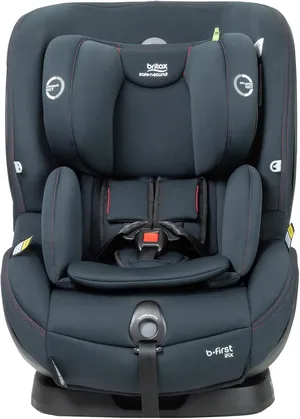
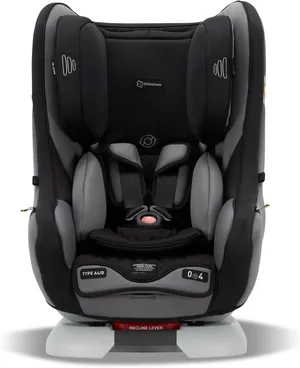
Check CREP before you buy. A seat can be AS/NZS 1754:2013 certified and still score poorly on CREP usability, which in practice means it is more likely to be installed wrong. The top-tier seats on CREP for convertible (birth to 4 years) typically include the Britax B-First ifix, the Maxi-Cosi Pria 2025 Refresh, and the Infasecure Attain More.
Rear-Facing Best Practice and Extended Rear-Facing
Australian law requires rear-facing to at least 6 months. International best practice, including the US AAP and Swedish safety research, recommends rear-facing as long as the seat allows, typically 2 to 4 years. Rear-facing is materially safer because the spine, skull and internal organs of a toddler are not strong enough to handle forward-facing crash forces until well past age 2.
When choosing a convertible seat, check the maximum rear-facing age and weight. The Maxi-Cosi Pria 2025 Refresh allows rear-facing to approximately 30 months, which is the longest window in the mainstream Australian market. The Britax B-First ifix and Infasecure Attain More both allow rear-facing to approximately 24 to 28 months depending on the child's height.
3-Across Install Reality for AU Families with Three Kids
If you have three kids and a C-segment car (Toyota Corolla, Mazda 3, Hyundai i30, VW Golf, Kia Cerato), you are constrained by physics. The rear bench of a Corolla is 131cm wide, and you need three car seats to fit in that width without interference. Most Australia convertible car seats are 44 to 48cm wide. Three 48cm seats total 144cm and do not fit. Three 44cm seats total 132cm and barely fit.
The only AS/NZS 1754:2013 certified convertible with an inbuilt harness that is narrow enough to sit consistently in a Corolla 3-across is the Infasecure Attain More at 42cm. The Britax B-First ifix at 44cm is borderline. The Maxi-Cosi Pria 2025 Refresh at 45cm interferes with outboard seat belts in a Corolla. If you have three kids and a small car, shortlist the Attain first. If you have a medium SUV or people mover (RAV4, CX-5, Kia Carnival) this constraint relaxes significantly.
ISOFIX versus Seatbelt Install
ISOFIX is the rigid lower-anchor system that most Australian cars from 2015 onwards ship with as standard. It is materially easier to install a seat correctly via ISOFIX than via seatbelt. CREP usability ratings for the same seat model are typically higher for the ISOFIX install mode than the seatbelt install mode. If your car has ISOFIX points, use them.
Every seat in this shortlist supports both ISOFIX 0-4 (with top tether) and seatbelt install. For older vehicles (pre-2015, or imported grey-market vehicles without Australian ISOFIX anchor points), seatbelt install is required. Seatbelt install adds 10 to 15 minutes to the first-time install and reduces your confidence that the install is correct. If you are driving a pre-2015 vehicle regularly, consider having Baby Bunting's in-store fitters do the install for you for a $40 fee. It is money well spent.
Australian Consumer Law and the 10-Year Shell Expiry
Car seats under AS/NZS 1754:2013 carry a 10-year expiry date from date of manufacture, stamped on the shell. After 10 years, the structural integrity of the plastic and foam can no longer be guaranteed to perform in a crash the way it did in certification testing. This is the hard ceiling regardless of wear.
Manufacturer warranty is typically 1 to 2 years. Britax Australia is 2 years, Maxi-Cosi Australia is 2 years, Infasecure Australia is 1 year. Australian Consumer Law extends your protection well beyond the sticker warranty. For a seat purchased at $500 to $800, a reasonable consumer would expect 8 to 10 years of working service, bounded by the shell expiry. If the harness, ISOFIX arms, or recline mechanism fail within that period from normal use, you have a consumer guarantee claim with the retailer under section 54 of the ACL. Start with the retailer (Baby Bunting, Britax Australia direct, Infa Group direct, Maxi-Cosi Australia direct), not the manufacturer's support line. Baby Bunting in particular has a dedicated car seat returns desk that handles these claims well.
Where to Buy and Retailer Comparison
Baby Bunting is the primary Australian car seat retailer, with in-store fitters at every location and a dedicated returns desk. They are the best first stop for most shoppers. Baby Kingdom, Baby Village, and Babyworth are secondary options with good price matching. Infa Group sells Infasecure direct. Britax Australia and Maxi-Cosi Australia both sell direct through their own websites.
Avoid grey imports and overseas purchases. A seat bought from an overseas marketplace such as AliExpress is unlikely to carry AS/NZS 1754:2013 certification and is illegal to use in Australia, even if it looks identical to the Australian variant. Check OzBargain for sale cycle timing: Baby Bunting runs the Britax B-First ifix at $549 (down from $699 RRP) about every 6 to 8 weeks, and the Maxi-Cosi Pria 2025 Refresh at $549 (down from $599 RRP) about monthly.
Final Checklist Before You Buy
Ask yourself: Does it carry the AS/NZS 1754:2013 sticker? Is it CREP-rated at childcarseats.com.au? Does it fit 3-across in my car if I have three kids? Does my car have ISOFIX points? Am I buying from an authorised Australian retailer, not a grey import? Have I factored the 10-year shell expiry into my timeline? Is the post-sale service network in my state decent?
If you are hesitant on the AS/NZS 1754:2013 certification question, walk away. That one is non-negotiable. Everything else is about fit, ergonomics, and how much you value post-sale service. The three seats I review in the best car seats list all pass the certification and CREP bar; the choice between them comes down to your car, your kid, and your budget.
My Top Picks
Ready to pick one?
Check out my ranked list with scores, prices, and AU availability.
See the Best Car Seats