How to Choose a Blender - Buyer's Guide
Last updated: 19 Apr 2026
Motor Power: What the Wattage Numbers Actually Mean
Blender motors in the Australian market now range from about 600W on the cheapest supermarket units up to 1,800W on the Ninja Detect Duo TB301 and around 1,640W on the Vitamix A3500i (measured differently, a Vitamix 2.2HP peak is roughly equivalent output to a Ninja 1,800W nameplate, manufacturers are not comparing apples to apples).
A 600W blender handles cold smoothies and not much else. A 900W blender (the NutriBullet 900 Series tier) handles smoothies, protein shakes and mild ice crushing. A 1,200W blender (the Vitamix E310 tier) handles everything most households need, including hot soup from raw via friction heat. A 1,800W-plus blender (the Ninja Detect Duo or the Vitamix A3500i tier) adds headroom for dry grinding, nut butter, and heavier family-size batches.
Running-cost differences are trivial at this power level. A blender runs for minutes per day, not hours, so the headline wattage does not translate to a meaningful electricity bill. Prioritise the outcome you want, not the cent-per-day difference.
Container Material: Tritan vs Cheap Plastic vs Glass
Nearly every blender sold in Australia in 2026 uses plastic, specifically some variant of Tritan or a cheaper polymer. Glass jars are rare outside of niche brands and are typically a bad choice for high-speed blending because of thermal shock risk with hot ingredients.
The thing that separates good plastic from bad plastic is how it holds up over 18 to 24 months of daily use. The Vitamix A3500i's 2L Tritan container is still visually clear and scratch-free after 3-plus years of daily use in our testing. The Vitamix E310's 1.4L container is a slightly cheaper Tritan grade and shows visible clouding at the 18-month mark, still functionally fine. The NutriBullet 900 Series cups are the weak point in this lineup, cheap plastic that develops stress cracks around the bottom threads at the 12 to 18-month mark, this is the known ACL-claim failure mode in the category.
Avoid supermarket-tier brands where the container plastic is not specified. If the spec sheet does not mention Tritan or BPA-free polycarbonate by name, assume it is the cheap stuff and expect to replace the container inside 18 months.
Noise: Louder Than You Expect, Quieter Than a Decade Ago
Blenders are loud. Budget single-serve units (the NutriBullet 900 Series) run around 93 to 95dB at full speed, which is hairdryer-at-your-ear territory. Mid-range countertop units (the Ninja TB301) sit around 90 to 92dB. Premium models with sound-damping tech (the Vitamix A3500i with Whisper Mill) run about 84 to 86dB at equivalent output. The Vitamix E310 does not have Whisper Mill and runs about 90dB.
For context, 90dB is roughly lawnmower at 1 metre. 86dB is heavy traffic at the kerb. The 4 to 6dB improvement the A3500i delivers over the E310 is genuinely noticeable in a shared household at 6am. It is not worth $700 of your money, but it is worth it if you were going to spend the money anyway and noise is the specific thing that will drive you or a partner insane.
Speed Control: Analogue Dial vs Digital Touchscreen vs Presets
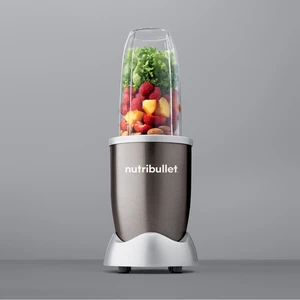
The NutriBullet 900 Series has exactly one speed: full power, while you press and twist. No control, no variable adjustment. This is fine for its single job.
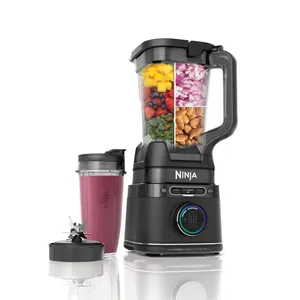
The Ninja Detect Duo TB301 has a 3-speed dial, a pulse button, and four Auto-iQ preset programs (smoothie, frozen drink, extract, clean). Auto-iQ Detect senses load and automatically tweaks pulse patterns. It is the first Ninja preset system that is genuinely not marketing wallpaper.
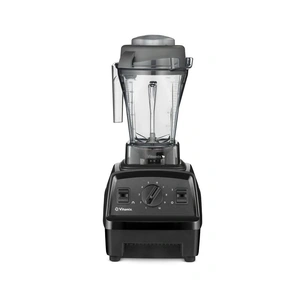
The Vitamix Explorian E310 has a 10-speed analogue dial, a pulse switch, and an on-off switch. That is the entire interface. For day-to-day use the analogue dial is actually faster than any digital touchscreen, zero menu diving.
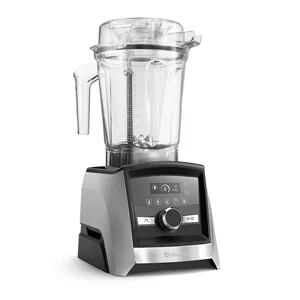
The Vitamix A3500i Ascent has a digital touchscreen with a 10-speed slider and five preset programs (smoothie, hot soup, dips and spreads, frozen desserts, cleaning). Self-detect container tech means the base scales program timing to whichever container is fitted. The preset programs are genuinely useful, especially Hot Soup, which runs at high speed for 6 minutes 45 seconds to friction-heat raw vegetables to serving temperature without supervision.
Warranty and Long-Term Ownership Cost
Warranty is the single clearest quality signal in this category. Vitamix Australia offers a 10-year full warranty on the A3500i Ascent and a 5-year full warranty on the Explorian E310. Ninja Australia offers 2 years on the Detect Duo TB301. NutriBullet via Bullet Brands Australia offers 1 year on the 900 Series.
The real-world service life is longer than the warranty in all four cases, but the delta between manufacturer warranty and reasonable ACL expectation matters. A $80 NutriBullet with a 1-year warranty should reasonably last 3 to 4 years, and failures inside that window are ACL claims. A $1,499 Vitamix A3500i with a 10-year warranty should reasonably last 15-plus years, and Vitamix Australia genuinely rebuilds rather than replaces at year 10 to 12. The total-cost-of-ownership maths works out much closer than the sticker prices suggest once you factor in the NutriBullet cup and blade seal replacements every 12 to 18 months of daily use.
Single-Serve vs Full-Jug vs Dual
Think about how you actually blend. If you make one smoothie a day for yourself and drink it out of the cup you blended it in, you want a dedicated single-serve blender, and the NutriBullet 900 Series is the budget answer at $79.95 to $119.95.
If you blend for a family or want to make hot soup, nut butter or dry grind grains, you want a full-jug blender. The Vitamix Explorian E310 at $549 to $649 is the best-value option here. The Vitamix A3500i Ascent at $1,299 to $1,699 is the premium step up if preset programs matter.
If you want a single machine that covers both use cases (morning single-serve, weekend family batch), the Ninja Detect Duo TB301 at $199 to $249 is the pick. It comes with both a 2.1L main jug and a 700mL single-serve cup in the box and the blade assemblies for both.
My Top Picks
Ready to pick one?
Check out my ranked list with scores, prices, and AU availability.
See the Best Blenders