How to Choose a Budget Smartphone - Buyer's Guide
Last updated: 25 Apr 2026
Budget in 2026 Means $300 to $700, Not $200
Budget smartphone pricing in Australia in 2026 sits at $300 to $700 for a phone that genuinely meets daily-use expectations. Below $300 you are in the territory of basic Android phones with weak cameras, slow chips, and 2-3 year realistic lifespans. Above $700 you are in lower-mid-range or upper-mid-range, which are different categories.
The good news in 2026: the budget tier has caught up substantially on the things most buyers care about. A $499 Pixel 9a or $499 Galaxy A55 now delivers: 6.5-inch OLED display at 90-120Hz, all-day battery, dual rear camera with capable main sensor, 5G connectivity, contactless payments, and 5-7 years of OS updates. Five years ago that would have been $900 territory. The mid-range and flagship tiers exist now mostly for camera quality, build materials, and incremental polish.
iOS vs Android at the Budget Tier
The OS choice matters even more at the budget tier than at flagship because Android and iOS have different price-to-performance curves.
iPhone 16e ($999 in Australia as of 2026) is Apple's budget iPhone, replacing the iPhone SE line. Single rear camera, A18 chip (same as iPhone 16 base), no MagSafe, basic 60Hz LCD-equivalent display. The $999 price point makes this tier overlap with mid-range Android territory, which is the trade-off for iOS access. If you specifically want iOS and cannot stretch to a $1,500 iPhone 16, this is the path.
Pixel 9a ($699) is the genuinely best-value smartphone in Australia in 2026. Tensor G4 chip, 6.3-inch OLED at 120Hz, 8GB RAM, dual rear camera with the same Pixel computational photography pipeline as the Pixel 9 Pro, 7-year software support commitment from Google, all the modern features (5G, contactless, biometric unlock). Beats the iPhone 16e on most spec dimensions at $300 less.
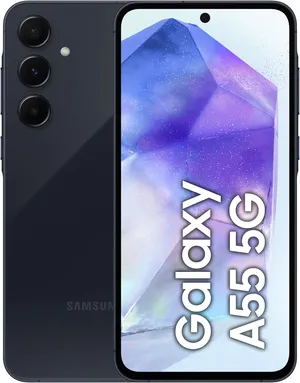
Samsung Galaxy A55 ($599) is the volume Android budget pick. Exynos 1480 chip, 6.6-inch Super AMOLED at 120Hz, 8GB RAM, triple rear camera. Samsung's One UI is heavier than Pixel's stock Android. 4-year OS update commitment (less than Pixel's 7). Strong Australia carrier support and Samsung's wide Australian service network.
Nothing Phone (3a) ($599) is the design pick. Snapdragon 7s Gen 3, distinctive transparent rear with Glyph LED interface, clean Nothing OS (Android-based with minimal bloatware), 6.77-inch AMOLED at 120Hz. Smaller Australian service footprint than Apple, Samsung, or Google.
For most buyers in 2026, the Pixel 9a is the recommended budget pick. It is the right phone for the largest share of buyers who do not specifically need iOS or Samsung's One UI.
What You Trade Off vs Flagship
Understanding what budget gives up versus flagship helps decide if the upgrade is worth it.
Camera: budget phones typically have one or two rear cameras versus three on flagships. The main camera on a $499-699 phone is genuinely good for daylight shots and capable for low-light with computational help. What you lose: dedicated telephoto (no real optical zoom past 2x), dedicated ultrawide quality, and the cinema-grade video (4K HDR, ProRes). For everyday social media photos and casual video, budget cameras are now genuinely competitive.
Display: budget OLED panels at 90-120Hz are excellent in 2026. The differences versus flagship are peak HDR brightness (700-1,200 nits versus 2,000+ nits) and slight colour accuracy variance. In bright Australian sunlight, the brightness difference is real; for indoor use, indistinguishable.
Performance: budget chips (Tensor G4, Snapdragon 7s, Exynos 1480, Dimensity 8200) are 30-40% slower than flagship chips on raw benchmarks. In actual app launching, scrolling, and most day-to-day use, the difference is invisible. Where it shows is heavy gaming (Genshin Impact at high settings drops frames on budget chips) and demanding camera processing (longer Night Sight processing times).
Build: budget phones use plastic or aluminium frames with Gorilla Glass 5 or 6 backs, versus flagship's titanium or aluminium with Gorilla Victus 2 or Ceramic Shield. Budget phones survive drops at similar rates; the premium build feels more substantial in hand but does not necessarily last longer.
Wireless: most budget phones in 2026 lack wireless charging. iPhone 16e has no MagSafe. Pixel 9a has 7.5W Qi charging. Samsung A55 has no wireless. If wireless charging matters to your daily life, factor it in.
Australian Carrier Compatibility
All budget smartphones sold by Apple Australia, Samsung Australia, Google Australia, and Nothing Australia are unlocked and support all Australian carrier 5G bands. Carrier-locked variants from Telstra Direct, Optus Direct, and Vodafone Direct have minor cosmetic differences but functionally identical to unlocked.
The grey-market problem is bigger at the budget tier. Some online retailers sell Asian-market or US-market budget Androids at $50-100 below Australian recommended retail price, but the Australia 5G band coverage and carrier provisioning will be incomplete. A grey-market Pixel 9a from MobileCiti.com.au is fine (they import the Australian SKU); a grey-market unit from Aliexpress may lack n78 5G band on Telstra. Check the spec sheet against Australian carrier band requirements before buying grey-market.
Dual-SIM: Pixel 9a, Galaxy A55, and Nothing (3a) all have eSIM plus physical SIM. iPhone 16e is eSIM-only in Australia.
Software Support: The 5-Year Question
Software support runways have transformed at the budget tier in 2025-2026.
iPhone 16e: Apple typically gives 6+ years of iOS updates. iPhone SE (2nd gen) from 2020 still gets iOS 18 in 2026.
Pixel 9a: Google committed to 7 years of OS updates plus security patches (announced 2024). Will receive Android 22 in 2032.
Samsung Galaxy A55: Samsung committed to 4 years of OS updates and 5 years of security patches on the A-series. Less than Pixel but still longer than the historical Android norm.
Nothing Phone (3a): 3 years of OS updates and 4 years of security patches. The shortest of the four; budget Nothing buyers are typically expecting to upgrade after 2-3 years anyway.
The Pixel 9a's 7-year support commitment specifically changes the long-term value math at the budget tier. A $699 Pixel 9a in 2026 will still be receiving Android 22 in 2032; that is iPhone-tier support at half the iPhone price.
Australian Price Tiers in 2026
Entry-budget ($300 to $499): Galaxy A35 ($399), Motorola Moto G Power, basic Xiaomi Redmi configurations. Adequate for second phones, kids' phones, parents who want simple. 60-90Hz OLED, basic single or dual camera, 4-5 year support runway. Expected lifespan 3-5 years.
Solid budget ($500 to $700): Pixel 9a ($699), Galaxy A55 ($599), Nothing Phone (3a) ($599), Motorola Edge 50 Pro. The sweet spot for primary phones on a budget. Premium features (AMOLED 120Hz, capable cameras, 5G, contactless), reasonable software support runways. Expected lifespan 5-7 years.
Lower mid-range ($700 to $999): iPhone 16e ($999), Pixel 9 ($999), Galaxy S25 FE ($899), OnePlus 13R. Crossover into the upper-mid territory. Worth it if you specifically need iOS access (iPhone 16e) or want flagship-equivalent silicon at slight savings.
Sales matter. JB Hi-Fi, Officeworks, The Good Guys, and online retailers like MobileCiti, Mobileciti, and Catch all run major budget smartphone sales around EOFY (June), Black Friday (November), Click Frenzy (May, November), and Boxing Day (December). A $699 Pixel 9a drops to $599 routinely. Trade-in programmes from Samsung Direct and Google Store can drop effective price by $100-300 for buyers trading older Android hardware.
Where to Buy and ACL Coverage
ACL for budget smartphones follows the same retailer-first rule. Reasonable-durability standard for a $500-700 phone is 3-5 years.
JB Hi-Fi stocks all major budget brands at competitive pricing. Care Plus extended warranty rarely worth it on budget phones because the ACL covers most failure modes.
Apple Store Australia for iPhone 16e: rarely cheapest, cleanest warranty path, AppleCare+ available at $129/year for accidental damage cover.
Google Store Australia for Pixel: direct channel with trade-in programmes; usually competitive on price.
Samsung Australia direct for A-series: aggressive trade-in programmes drop effective price meaningfully.
Officeworks, The Good Guys, Big W all stock budget smartphones at competitive pricing. Strong ACL paths.
Telstra, Optus, Vodafone direct: 24-month financing plans on budget phones. Carrier-locked unit makes resale slightly harder.
MobileCiti, Catch, Kogan are Australian online retailers that often beat the chains on price. Verify they sell the Australian SKU (not grey-market) before buying.
Avoid grey-market unless you confirm Australia 5G band support. Save money through retailer promo codes and trade-in programmes instead.
My Top Picks
Ready to pick one?
Check out my ranked list with scores, prices, and AU availability.
See the Best Budget Smartphones (Under $500)